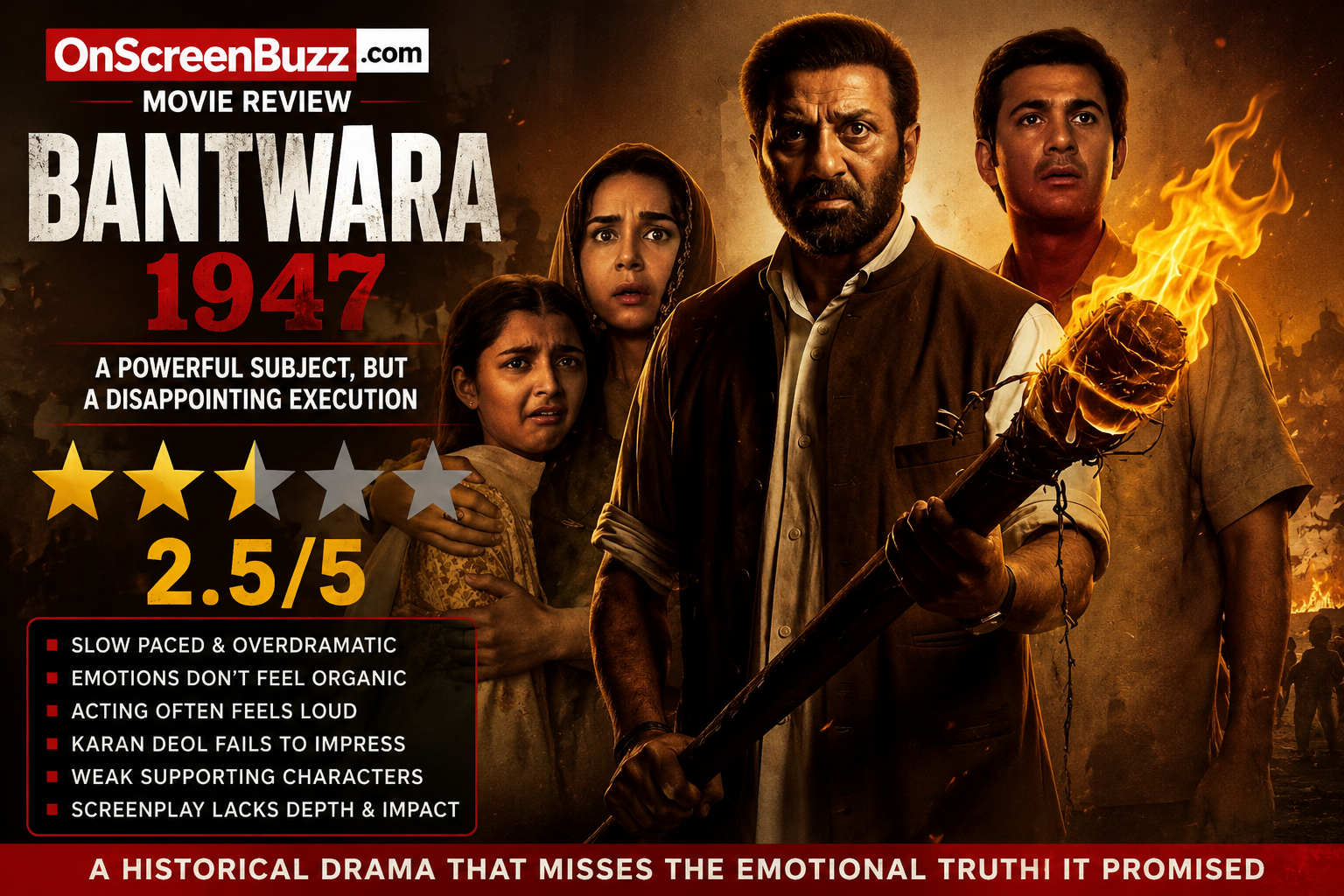
Rating: ⭐⭐½ (2.5/5)
Rajkumar Santoshi and Sunny Deol coming together naturally raises expectations. After films like Ghayal, Damini and Ghatak, the duo returning with a story set against the Partition of 1947 promises a powerful cinematic experience. Unfortunately, Batwara 1947 never fully lives up to the potential of its subject. The film has a strong premise and some good performances, but its slow pace, overly dramatic treatment and emotions that often don't feel organic make it less impactful than it should have been.
Story
Set during Partition, the story follows Sikandar Mirza (Sunny Deol) and his family after they arrive in Lahore. They find a house where Mai (Shabana Azmi), an elderly Hindu woman, is already living and refuses to leave her home. As Sikandar and Mai initially clash over the house, their relationship gradually changes and develops into an emotional bond.
The idea of finding humanity amid communal hatred is strong, but the screenplay doesn't always do justice to it. The story moves at a slow pace and several developments are predictable. At times, the film spends too much time establishing emotions that could have been conveyed more naturally and efficiently.
Performances
Sunny Deol and Shabana Azmi are the strongest performers here. Sunny brings his familiar authority and intensity to Sikandar, but some scenes feel too loud and overdramatic, which takes away from the emotional impact. Shabana is much more natural and gives Mai warmth and emotional weight. Preity Zinta is good but her character could have been developed better. Karan Deol is one of the weaker links; his dialogue delivery and emotional scenes don't always have the required impact. The supporting cast has its moments, but several characters feel underwritten.
Direction
Rajkumar Santoshi's signature style is clearly visible—strong dialogues, lengthy confrontations and heightened drama. But the treatment often feels dated. The biggest issue is the pacing. The film takes too long to reach several of its emotional and dramatic payoffs, making portions feel stretched.
More importantly, the emotions don't always feel organic. There are moments where the situation itself is powerful enough, but the film adds extra dialogue, background music and dramatic reactions to underline the emotion. A tighter edit and a more restrained approach could have made the film considerably more effective.
Technical Aspects
The film makes a sincere attempt to recreate the atmosphere of Lahore during Partition through its locations, houses, streets and crowds. The cinematography is decent, though it doesn't consistently deliver the visual scale expected from a period drama of this magnitude. The production design shows effort but could have been more detailed and authentic. Some of the larger crowd and train sequences do create an impact, but the technical quality isn't consistently impressive.
Music
The music supports the emotional tone of the film but doesn't leave a particularly strong impression. The background score often works a little too hard to amplify scenes that are already emotionally loaded, further contributing to the film's overdramatic feel. There isn't a song or theme that stays with you long after the credits.
Final Verdict
Batwara 1947 has a powerful subject and a few strong performances, particularly from Sunny Deol and Shabana Azmi. But the slow pace, weak screenplay, loud performances and emotions that often feel manufactured hold the film back.
Karan Deol and several supporting characters also fail to make the desired impact.
The film wants to make a strong statement about humanity during one of the darkest chapters of Indian history, but the journey towards that message is unnecessarily long and overly dramatic.
A powerful subject, good performers and a few moving moments—but Batwara 1947 never finds the cinematic grip needed to become a truly memorable Partition drama.
Rating: ⭐⭐½ (2.5/5)